“Expose the Boil”: House Bills 322 and 327
 July 2, 2021
By Alison Paxson, Communications & Policy Associate
Governor DeWine signed into law the final 2022-2023 state budget for Ohio this week, which includes a provision that makes Juneteenth an official state holiday to commemorate June 19, 1865, the date when enslaved people in Confederate states were finally freed.
Ironically though, as Ohio declares Juneteenth a state holiday, officially giving government employees and school children time off to observe it, two pieces of legislation are gaining momentum in the Ohio legislature that would ban teaching the very reasons why we celebrate it.
House Bill 322 and House Bill 327 are currently being heard in Ohio’s House State and Local Government Committee, where they have had two hearings so far for sponsor and proponent testimony. These bills would actively censor and restrict how teachers can discuss racism and sexism in K-12 classrooms and limit professional development and training that teachers and staff can receive relating to certain topics the bills vaguely label as “divisive.”
What will and will not be allowed is vague and unclear in both bills. For instance, one “divisive concept” prohibited by HB 327 is: “The concept that members of one nationality, race, color, ethnicity, religion, or sex attempt to treat others disrespectfully based upon nationality, race, color, ethnicity, religion, or sex.” Does this mean banning any class material that touches racism, sexism, or any type of discrimination broadly? We do not know. Unfortunately though, the uncertainty and fear of public backlash and any legal ramifications are already having an effect, intimidating teachers, districts, and school boards, regardless of whether the laws have been passed or not.
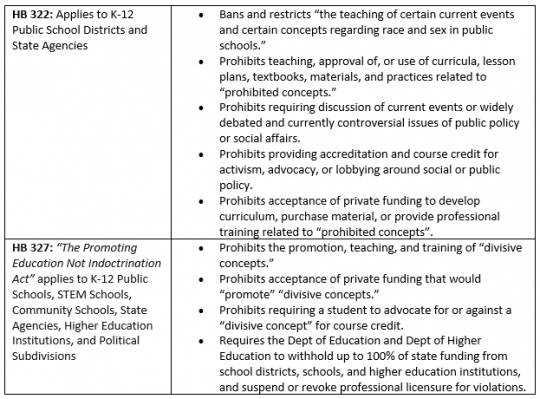 Although the bills leave what is banned up to broad interpretation, the language regarding the consequences for violating these laws is clear. Both bills would make it so that any course a student takes that covers “prohibited” or “divisive” concepts cannot count as credit towards graduation. Moreover, as laid out in HB 327, if a school or school district is found to knowingly violate this law by engaging in these concepts, the Department of Education would be obligated to withhold 25% of state funding for the first offense, 50% for the second, and 100% of all state funding for the third. Teachers and staff found in violation could also have their professional licenses suspended or revoked.
Whether it is the loss of a truth-based education or a severe curtailing of state funding to their school, our children stand to lose the most from either scenario. All children benefit from teaching and curricula that imparts honesty about who we are, integrity in how we treat others, and courage to do what’s right.
Infants as young as six months can distinguish differences in skin color. By age three, children are already forming judgments of racial differences based on their observations of the world around them. As they grow, they hear the news, see what is on television, and witness prejudice and racism either directly or indirectly. Having low expectations of what children are capable of feeling, thinking, and understanding based on their age denies their lived experiences in a way that is traumatizing. It dismisses the capacity and potential of every child – not just those in honors or gifted courses – for complex thought, experience, and growth. Silencing discussions on race and racism harm children further by sending them the wrong message that these topics are taboo. Denying racism, its impacts on individuals, and silencing dialogue can lead to negative and false assumptions grounded in fear that can generate feelings of isolation, discomfort, anxiety, confusion, and disillusionment, especially as children grow older. Children need a frame of reference and safe space for understanding and thinking through race and the impacts of racism on themselves, their peers, and their society
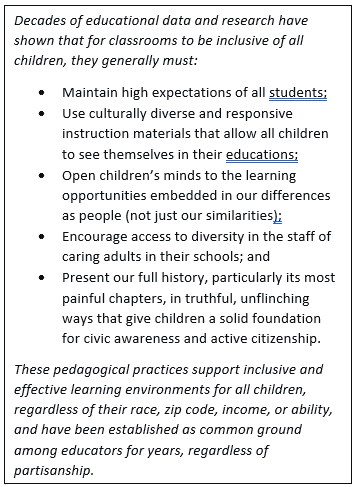 Moreover, every educator knows that for students to be invested in their education, their curriculum must be relevant to and reflective of their everyday lives. As John Dewey argued more than 100 years ago, curriculum must start with a child’s neighborhood and community at its center, recognizing a child’s lived experience as an asset to their own learning and to that of their peers. This is a fundamental part of creating a classroom that is conducive to learning, and yet, this would be impossible to achieve if aspects of a child’s own lived experience were banned from classroom dialogue, as Ohio’s HB322 and HB327 threaten to do.
Unfortunately, though, educational quality is not the main driving force behind pushes for legislation like this. There are much more pernicious influences at play, catalyzing momentum for bills like these that have been passed or introduced in over 25 other states across the country over the last couple months.
Across the nation, we are witnessing lawmakers attempting to leveraging cultural anxieties for political benefit. This is centered around the new catch-all term for these anxieties, “Critical Race Theory,” a term few can define, but many can point to for anything they find culturally unpopular for their political base.
Critical Race Theory (CRT) is the graduate level framework for examining how racism in our institutions has impacted our society. As sociologist Crystal M. Fleming has noted, the framework does not identify “white people” as the problem – although this is a popular talking point used to rationalize the need for bills like HB 322 and 327 – the problem this framework actually identifies, she says, is “white supremacy and legalized oppression.” At its base, Critical Race Theory is a fabricated point of contention to create divisions between people.
The Critical Race Theory framework is not taught in K-12 schools, but it has nonetheless become the broadly defined bogeyman to protect our schoolchildren from. (Sadly, in this scenario, our children have become convenient scapegoats for a culture war at the expense of their educations and long-term wellbeing.)
Preliminary results from a recent national poll show that Americans have deeply divided opinions along partisan lines of how we should look back on our history. Some may argue that this is a turnout tactic, and it is nothing new, but it does make our national imperative for truthful, accurate, and complete history education that much more important, especially as this is specifically what is under attack to seal divisions along racial lines.
But consider the example of Juneteenth, where understanding the full scope of the event could not be more important for how to do both, and therefore, does justice to those who experienced and endured this period of our history. Juneteenth is not just about celebrating the end of slavery in the Confederacy. It also marks a day of necessary recognition that white slaveowners lied for years about their slaves’ freedom so they could preserve the economic system of slavery they benefitted from, even though the Emancipation Proclamation had technically outlawed it over two years earlier.
This bears great importance to how we understand what is happening today and not only why bills like HB 322 and 327 are being introduced in multiple states, but, why the strawman of Critical Race Theory has been so persuasive to people from different backgrounds and rungs of American society.
It is the push and pull of advantage and disadvantage that preserves the status quo within a society, that gave racism its legal and material foundation by drawing “the color line” all the way back in the 1600’s, and it perpetuates marginalization in our society today, no matter how unjust it is to the collective wellbeing of all of us. As a nation, we find ourselves in such a moment that epitomizes this push and pull of power relations, and as people, we are ripe for plucking, to be divided and conquered, if we don’t know the history for how we got here and who stands to benefit from the deep antagonisms of racial conflict that are being stoked right now.
Racism first found its legal and material foundations on this soil because of manufactured divisions along racial lines to prevent white indentured servants and Black enslaved Africans from uniting against their oppressors who, though they had property and privilege, were technically a minority in number and feared the solidarity of the laborers they exploited for economic benefit. At the time, differences in race and skin color were not enough to keep these oppressed people with common interests apart. Although our country’s racial divisions run deep, it was not until laws to divide us were intentionally created, for instance, harsher punishments imposed for enslaved Black people who ran away from their oppressors than for white indentured servants, that a system of differential treatment, of structural racism, was established and racial castes was hardened.
Not understanding our own history allows us to be more easily susceptible to similar “divide and conquer” strategies today, as exemplified with the manufactured crisis of Critical Race Theory, that may look different but have the same cracks in their foundations.
Worst of all for the well-being of our children and our future is that these made-up problems obscure the real challenges our state and communities are facing that both our attention and resources would be better focused on. According to U.S. Census Household Pulse Survey Data, in Ohio:
- 28% of Black households in Ohio with children sometimes or often did not have enough food to eat, compared to 11% of white families, during the pandemic.
- 23% of households with children reported feeling down, depressed or hopeless in 2020, and the responses didn’t show any improvement in March of 2021.
- 43% of Latinx or Hispanic families and 42% of Black families had little or no confidence in their ability to pay their next rent or mortgage payment compared to 15% of white families.
- Nearly 50% of Ohio households where at least one household member planned to take classes from a college, university, community college, trade school or other occupational school in fall of 2020 took fewer classes or cancelled their plans, and likely many who left will never return.
- 1 in 10 Ohio adults do not have health insurance in 2021 – thereby making it more likely their children are not enrolled either.
An attack on our history is an attack on our future, on our children’s future well-being.
The words of Dr. Martin Luther King, Jr. have been quoted often in testimony to support these bills in white-washing and censoring our children’s educations, with one lawmaker even stating during testimony for HB 322 that King would be “rolling in his grave” were he to see how race was discussed in schools today. But while these quotes center on his dream for a society where children “will not be judged by the color of their skin but by the content of their character,” they ignore the expanse of his legacy and co-opt his image for their convenience, just as they might selectively pick out which parts of our history are appropriate to teach or discuss.
King wrote in his 1963 Letter From a Birmingham Jail. “We who engage in nonviolent direct action are not the creators of tension. … We bring it out in the open, where it can be seen and dealt with. Like a boil that can never be cured so long as it is covered up but must be opened with all its ugliness to the natural medicines of air and light, injustice must be exposed, with all the tension its exposure creates, to the light of human conscience and the air of national opinion before it can be cured.”
Legislation, like House Bills 322 and 327, taps into the fear, guilt, and rage generated by this boil of racism being exposed. Despite this fear and anger, we must work diligently to continue to expose the boil to create a better and more just world where all children can thrive.


